Two hawsers lie on a quay, each as thick as a man's wrist, stiff with tar and salt. They have to become one line long enough to reach a buoy, and they have to come apart again afterwards. Nobody reaches for a square knot, and nobody reaches for a bowline. An experienced hand makes two loops, weaves them together, works the result flat with his palm, and puts the strain on. That weave is the carrick bend, and for a few centuries it was the difference between a ship that could be moved and one that sat where it was.
It is not the most famous knot in the world. It rarely appears on a yacht, and it is out of place on a climbing harness. But in the age of sail, when everything heavy moved by rope, the carrick bend was the joint that trade actually depended on.
A Bend, Not a Hitch
Knots are usually sorted into two families. A hitch ties a rope to something else — a post, a ring, another rope's standing part. A bend joins two ropes end to end. The carrick bend is a bend, and it looks like one: two interlocking loops, laid over and under each other in an alternating pattern, with the two working ends exiting at diagonally opposite corners.
Where the name comes from is not settled. One explanation points to Carrick, the old district in Ayrshire, Scotland. Another ties it to the carrack, the broad, high-sided merchant ship that carried so much Mediterranean and Atlantic cargo in the fifteenth and sixteenth centuries. Both stories are plausible, and neither can be proven. What matters is that the knot was already old when the people who used it started writing things down.
Why Heavy Hawsers Needed Their Own Knot
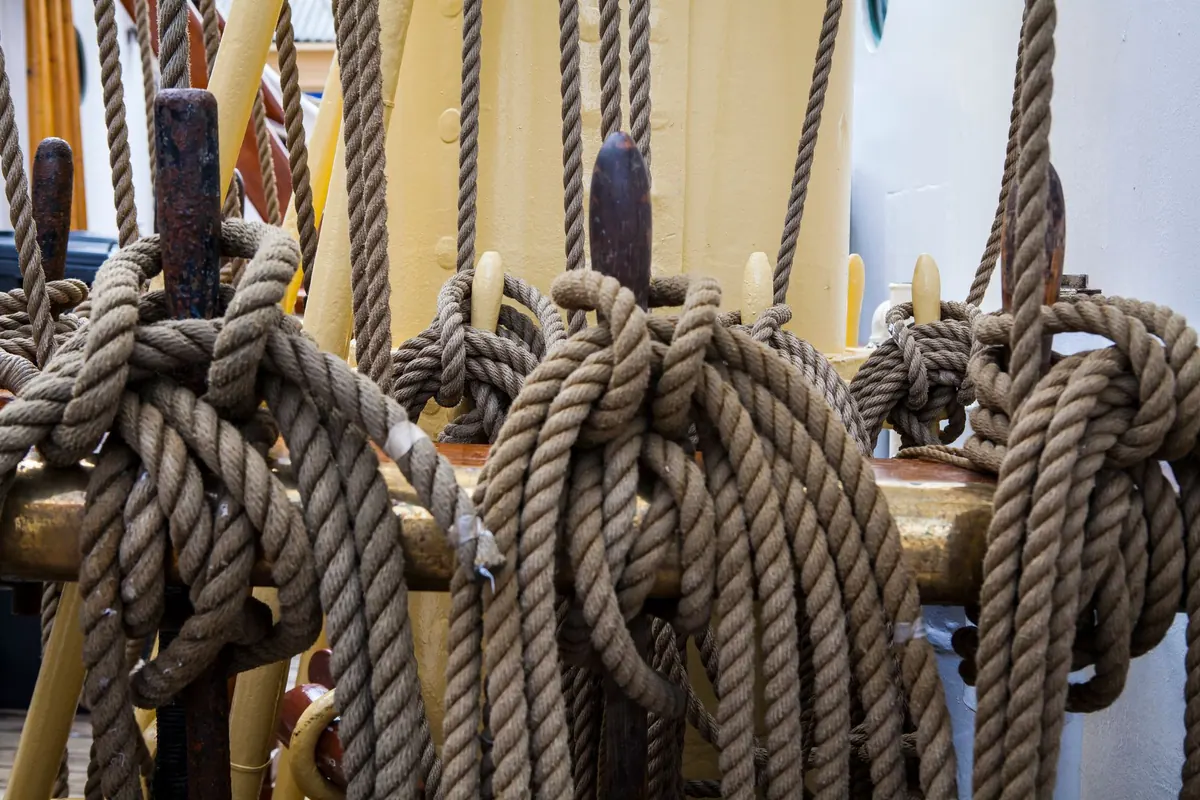
A hawser is not rope the way a dinghy's painter is rope. It is large — commonly several inches in circumference — and it is stiff. Tarred manila in cold weather behaves less like cord and more like a cable. Wet it, dry it, wet it again, and it hardens further.
That changes the design brief completely. A knot for hawsers has to do four things at once:
- Hold in rope too stiff to bend into a tight, tidy tuck.
- Accept two lines of different sizes, because a crew joined whatever was on board.
- Come apart after it has been under load, because hawsers were expensive and were expected to be reused for years.
- Be inspectable by eye, at night, by a tired person, on a wet deck.
The carrick bend answers all four. It is built from open loops rather than tight turns, so thick rope can still be worked into it. It does not jam, which is precisely the quality that made it valuable — a bend that has to be cut out of a hawser is a bend that quietly costs the owner money. And because the two loops weave rather than crush, a wrong tuck is visible. You can look at it and see whether the pattern is right.
The shape matters more than the tightness
The carrick bend is usually left in its open, woven form and loaded that way, rather than being hauled up small and hard. Before taking the strain, sailors worked it flat with the hand or a mallet so the strands seated evenly. A flat, evenly woven knot takes load predictably. A knot dragged tight while it is still twisted takes load in a way nobody can predict.
What a Rope Joint Did for Trade
Think about the jobs that needed a long, strong line and could not be done with a short one.
Kedging. A ship aground in soft ground could carry an anchor out in a boat, drop it, and then haul the ship toward it on a hawser. Do that once, and the anchor has to be recovered and carried out again. In a wide, shallow estuary, that work could take a whole tide or more, and every extra fathom of line extended the reach. Joining two hawsers safely turned a short kedge line into a long one.
Warping. In harbours with no room to sail, ships were hauled along by lines run to rings, posts or anchors. Warping a vessel through a narrow harbour mouth or up a river takes many lengths of line and a great deal of joining and unjoining. A bend that could be undone quickly, in the dark, without cutting, kept that slow work moving.
Towing and tracking. Boats, and later steam tugs, towed sailing ships through calms and into harbour. On rivers and early canals, lines ran to shore crews. All of it depended on long tows made from shorter lines.
The commercial effect is not mysterious. Time in port and time becalmed are both dead time, and dead time is the expensive kind. A crew that could rig a long tow in minutes, take the strain, and then break the whole thing down again without destroying the rope, moved cargo on schedules that a crew without that skill could not match. Multiply that by every harbour on a route and you have a shipping trade that behaves differently.
Tying It: Build the Weave
The carrick bend is easier to learn with two lengths of cord in two colours. Once you can see what the pattern is doing, thick rope makes sense.
- Lay the first rope out and form a loop, with its working end lying across the standing part.
- Take the working end of the second rope and pass it under the near side of that loop, from the outside in.
- Carry it over the far side of the loop, then down and under the first rope's end where it crosses the loop.
- Finish by passing the second end under its own standing part, so that it comes out at the corner diagonally opposite the first rope's end.
Then stop and look at it. The finished knot should lie flat like a small woven mat, and each strand should pass alternately over and under its neighbours. The two ends should exit on opposite corners. If both ends come out on the same side, the weave is wrong — untie and start again rather than hoping the load will sort it out.
Working with rope that does not want to cooperate
With stiff hawser, do not fight it. Lay the loops generously, and let the rope tell you how large the turns need to be. If the line is very hard-laid, a couple of half hitches taken in the ends after the bend is formed will keep the weave from working loose while you handle it. On the old working boats, that was routine.
Where It Still Earns Its Place
The carrick bend never disappeared; it moved sideways into the corners of the trade where heavy line still gets handled by hand.
- Traditional and replica rigging, where large natural-fibre lines are joined for towing and mooring.
- Joining lines of unequal size, which is where a bend built from two independent loops does better than most.
- Decorative ropework — bell lanyards, mast ropework and small fancywork, where the woven symmetry of the knot is the point.
- Teaching, because few knots make the over-and-under logic of a proper bend so visible.
One caution for modern line. Nylon,
Photo: jackmac34 / Pixabay