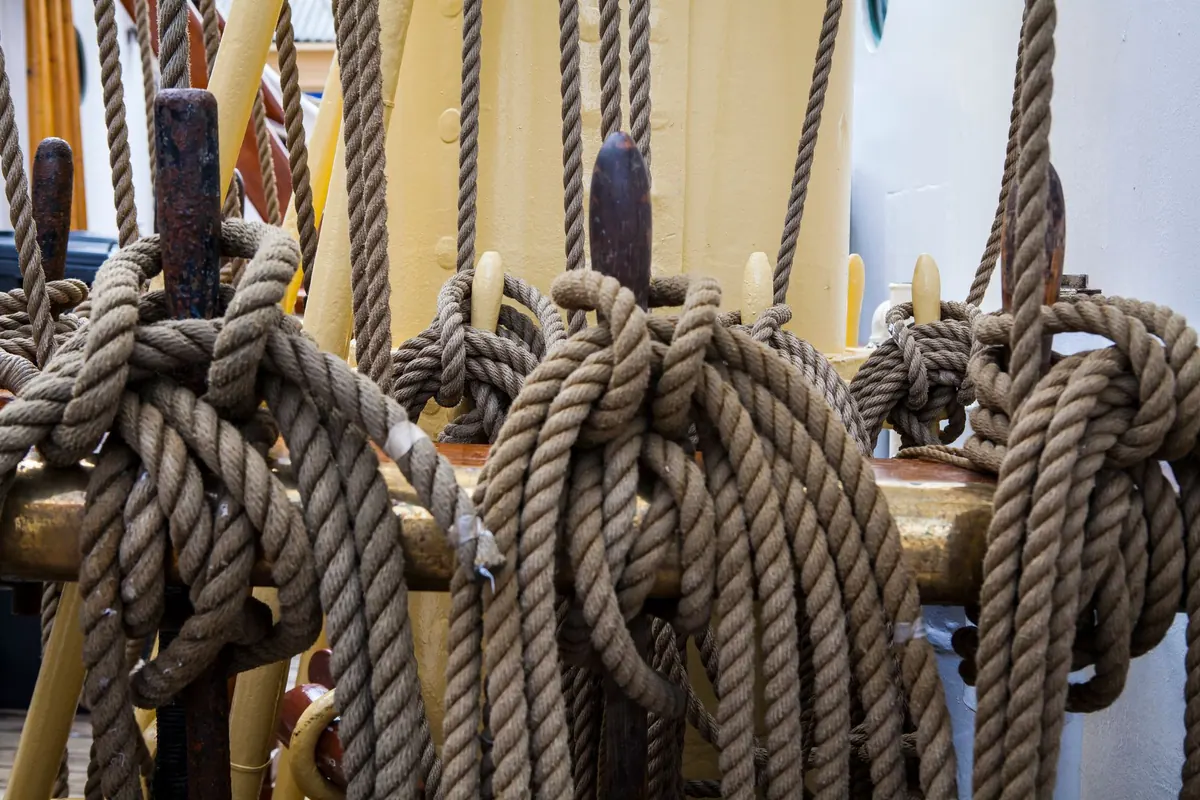
A sheet bend looks like something a child would invent: a loop in one rope, a tuck through it with the other, pull both snug. Then you load it and find that the whole thing grips harder the more you pull, and comes apart in two seconds when you want it to. That combination of grip and release has kept the knot in service for a very long time, and not only on boats.
What follows is the paper trail — where the name came from, how the knot got written down, and why a bend that predates most of our rigging vocabulary is still being tied on Tuesday afternoons in dinghy parks and on moorings.
What "Sheet" Actually Means
The word is older than the knot's modern name, and it has nothing to do with paper. It comes from the Old English scēata, a corner or an edge of cloth — the same root that gives us a bedsheet, meaning a large cloth. On a square-rigged ship, the sheets are the ropes that control the clews, the lower corners of a sail.
Here is the detail that gets lost: a sail's clew almost always carries a cringle or a thimble, a hardened eye rather than a loose end. So the sheet bend in its strictest sense is the bend used to fasten a sheet to a sail's corner — a rope-to-eye job, not a rope-to-rope one. The knot happens to do both well, but the eye is where it first earned its keep, which is why the term appears in rigging inventories long before anyone thought to publish a book of knots.
Before the Name: Weavers, Net Makers and Fishermen
The structure is far older than the name attached to it. Weavers joining broken warp threads used a knot with essentially the same geometry — two interlocking bights, each capping the other as tension comes on. It is usually called the weaver's knot, and the resemblance to a sheet bend is not cosmetic; the mechanics are identical.
The same form turns up in net repair, in fishing gear, in basket and mat work, anywhere a person has to join a thin cord to a thicker one without resorting to a splice. Knots of this kind tend to be found repeatedly rather than invented once, because the problem is universal and the solution is short. A sailmaker in Bristol, a net mender in a Portuguese harbour and a weaver at a loom were all solving the same puzzle: how do you join two cords of different sizes so the thin one cannot simply pull out?
The Age of Sail and the Printed Manual
For most of maritime history, knot knowledge moved hand to hand. A boy learned from an older hand, and a mistake was corrected with a shout and a demonstration. That changed in the late eighteenth and early nineteenth centuries, when rigging became a written and illustrated discipline. David Steel's Elements and Practice of Rigging and Seamanship appeared in 1794; Darcy Lever's The Young Sea Officer's Sheet Anchor followed in 1808. Both put knots onto engraved plates with names attached, so the sheet bend could be drawn with its working end and its bight clearly distinguished.
Printed plates did something oral tradition could not: they froze a name to a form. A mate who had learned the knot in one port could be checked against a book in another, and a captain could insist on consistency across a crew. Standardisation was still partial — sailors were famously generous with synonyms, and a knot that had four names in one navy might have two in another.
Becket Bend, Weaver's Knot and the Naming Problem
A becket is a short loop of rope, or a small fitting, used to hold something — a ready-made place to bend a line. Bend a halyard to a becket and you have a becket bend. In practice, sheet bend and becket bend are often used interchangeably, though some riggers reserve one term for bending to an eye and the other for joining two lines end to end. The weaver's knot is the same family again, seen from the loom rather than the rail.
Knot literature reflects the confusion rather than resolving it. Ashley's Book of Knots, published in 1944, gives the sheet bend family dozens of numbered variants, which is really a comment on how many trades needed the knot and how few of them agreed on what to call it. None of this matters at the rail. If an old manual or a rigging shop mentions a becket bend or a weaver's knot, you almost certainly know the knot already.
Why It Outlasted Hemp, Wire and Manila
The sheet bend's real advantage is size difference. Joining a 10 mm line to a 16 mm one is awkward with most bends: the thin line walks, the fat one buckles, and the knot ends up ugly and unreliable. The sheet bend is built for that mismatch, because the bight of the larger rope acts as a soft eye for the smaller one to grip against. Hemp, manila, sisal, nylon, polyester — the principle survives the change of material.
- Unequal diameters. The bigger the difference, the more the knot makes sense. Twin lines of identical size are its weakest case.
- Easy to break. After heavy loading, a sheet bend usually comes undone with a push and a pull, where a fisherman's knot may need tools.
- Works to an eye. You can tie it to a thimble, cringle or becket without access to the far end of anything.
- Forgiving to tie. Gloves, cold hands, failing light, a boat rolling at anchor — it still goes in.
The limits are worth stating plainly. In slick, stiff modern cordage of similar diameter it can spill, especially under intermittent, jerky loads. The fix is simple: take an extra turn and tie a double sheet bend, which is noticeably more secure and only marginally slower. And it is not a knot for anything where failure would injure someone; climbing and rescue work use bends designed for that purpose. On a boat, for sheets, flag halyards, warps and temporary joins, it remains quietly excellent.
Tying It So It Holds
Form a bight in the thicker rope — a simple U. Pass the working end of the thinner rope up through the U, around behind both legs of the bight, then tuck it under its own standing part so it lies across the mouth of the U. Pull the thin line's tail and the thick rope's standing part together to set it.
- Dress the knot before loading it: the thin rope's tail should sit inside the bight, not outside it.
- Check that the thin line enters and leaves the bight on the same side. If it doesn't, you have a left-handed version that is markedly less secure.
- Leave a tail of at least four diameters, more in slick rope.
- For unequal or slippery lines, add a second turn — the double sheet bend.
- Set it by hand with a firm, steady pull. A knot that has never been seated can shift under its first real load.
Tie it a dozen times on a rainy afternoon and your hands will keep the sequence for decades. That is how this knot has always travelled: not through books, but through the small, repeated movements of people who needed two lines to become one.
Photo: diema / Pixabay